
The Bank of Canada held its policy rate at 2.25% on June 10, the fifth straight decision to leave it unchanged and the level it has held since October 2025. For buyers in Metro Vancouver, that keeps the financing element of the cost of a home steady, while the price element has fallen year over year.
The region-wide median across all types combined edged up over the year, but that is due to a higher proportion of detached homes selling this spring rather than any single home type gaining value. Every property type in the region is, in fact, selling for less than a year ago.
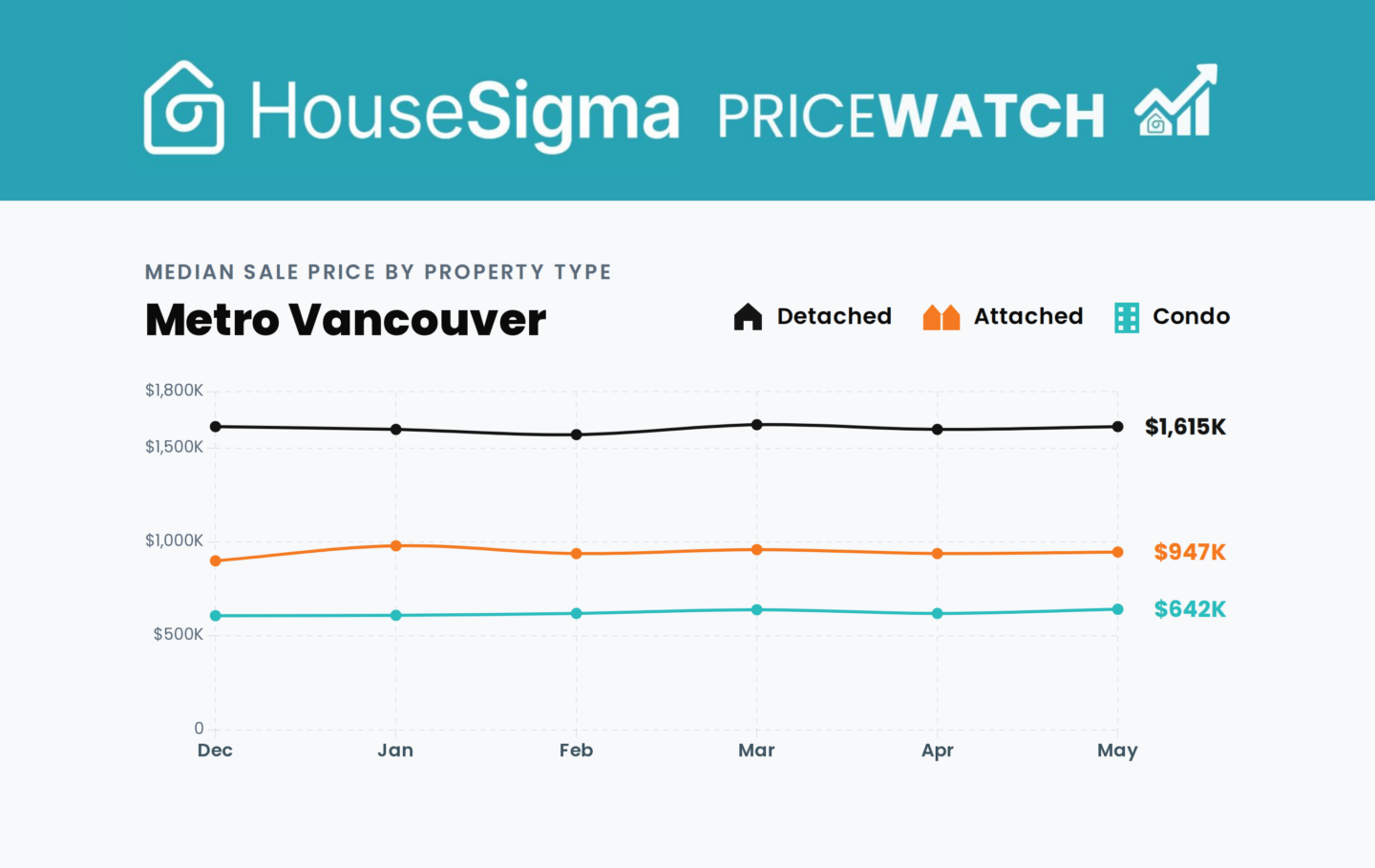
New HouseSigma data (see infographic below) has found that the median detached home sold for $1,615,000 in May 2026, down 5.0% from May 2025; attached homes sold at a median of $947,000, down 3.4%; and condos at $642,000, down 2.5%.
Those declines have been easing, though. The year-over-year gap has narrowed steadily through the spring — on detached homes to about 5% from 10% in January, and on condos to under 3% from 9% — and all three home types edged up in median sale price from April to May. So, prices still sit below last year, but the slide is flattening, not deepening.
Monthly mortgage costs vs last year
Because the interest rate held in today’s announcement, those year-over-year lower prices flow straight through to lower monthly costs for buyers, instead of being offset by pricier borrowing.
At a representative fixed rate of about 4.1%, with 20% down and a 25-year amortization, the monthly payment on a median-priced condo runs roughly $2,740 a month, down from about $2,810 a year ago. An attached home is near $4,040, down from $4,185, and a detached home under the same theoretical conditions would be about $6,895, down from $7,255. (This ignores the fact that most detached home purchases are less reliant on financing than condos, due to factors such as equity accrual and wealth transfer.)
That said, this payment relief is modest, and it is entirely the lower home price doing the work. It is also rate-dependent: a single quarter-point increase, which markets see as possible later this year, would add about $71 a month to that condo payment, almost exactly what the past year’s price drop saved.
Prices down, sellers negotiating, rates frozen since October. If you’re waiting for a better time to buy, I’d love to know what you’re waiting for. The data is practically begging you. I’m just the messenger!
Jeremy Bator, leading HouseSigma agent in Lower Mainland of BC
Sale vs list prices
Buyers held the upper hand on negotiation as well. Across the region, 82.7% of homes sold below their asking price in May, with the typical sale closing about 2.58% under list, a gap of roughly $22,500. Only 9.1% of sales finished above asking.
The discounting reached every property type, if not evenly: detached homes sold furthest below list at a median of 2.96% under, condos at 2.55%, and attached homes nearest to asking at 2.06% under.
A handful of sales sat well outside that pattern. The largest percentage premium over asking went to a two-bedroom White Rock ocean-view condo built in 2020, listed at $699,900 and sold for $850,000, 21.4% above list and the kind of bidding that was rare in May. The biggest dollar amount achieved over list price was a modern detached home in Vancouver’s Cambie neighbourhood, which sold for $6 million, $511K over its asking price.
The steepest discount in percentage terms was a 1930-built home, likely a teardown, on a corner lot in New Westminster. It was listed at $1,300,000 and sold for $910,000, 30% below asking. And in dollar terms, a West Vancouver waterfront condo listed at $10,898,000 sold for $9,275,000, a cut of more than $1.6 million.
What it all means for buyers and sellers
For buyers, May was a reasonably good moment to act, and that continues into June. Prices sit below last year, most sellers are taking offers under asking, and borrowing costs are steady. But the price relief is leveling off rather than building: the year-over-year price gap has been closing, so holding out for much deeper discounts is a weaker bet than it was over the winter, while a rate increase would press on affordability from the other side. Condo buyers, typically the most reliant on financing a large portion of their home price, are the most exposed there.
For sellers, the month rewarded pricing to the current market over last year’s expectations, since homes sold below asking in every category and an above-list result was the exception.
The number worth watching from here is less about the listing price and more about the all-in monthly cost of ownership, which hinges on the path of interest rates as well as on where prices go next.
Check out the full Metro Vancouver May 2026 PriceWatch infographic below for more details and breakdowns by area and property type. Mouseover or touch the price chart points to reveal the full data.
Find all your market trends data for Metro Vancouver here and keep up to date with our BC real estate blog here.