
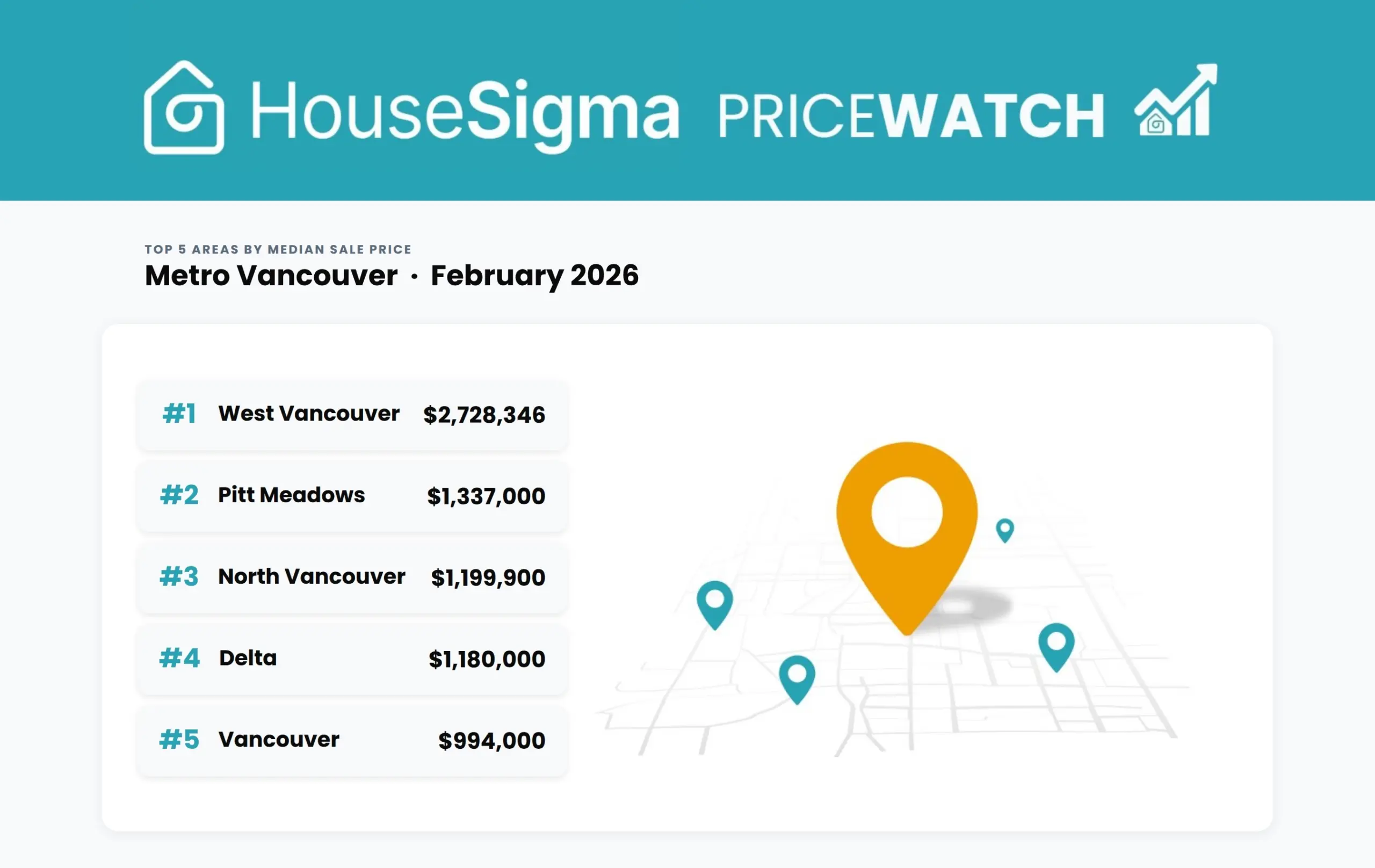
If you’ve been watching Metro Vancouver real estate and waiting for a signal to buy, February’s data is worth a closer look — not because of the headline year-over-year price decline, which is modest, but because of what’s sitting underneath it.
The year-over-year median sale price decline for February 2026 across the region was 1.2%. But look at each segment separately and the picture changes considerably.
Detached homes were down 9.6% year-over-year in February, with the median sitting at $1,572,000 compared with $1,739,450 a year earlier. That’s $167,000 off the price of the same type of home, in the same market, twelve months apart. Condos dropped 7.5%, bringing the February median to $620,000 versus $670,000 in February 2025. Attached homes fell 5.9%, to $938,800 from $997,250.
So why, if all home types saw YOY drops of around 6-10%, is the overall median YOY price decline only 1.2%? Because that figure is a blended median across all property types, and it’s being cushioned by a shift in the type of homes sold. In February 2025, condos made up 49% of all sales in the region, but in February 2026, that share had fallen to 46%. Given that condos are the lowest-priced segment, having fewer of them in the mix pulls the overall median upward, even as prices in every segment are falling.
Has the price slide bottomed out, or merely paused?
All three segments declined year-over-year in most months throughout 2025, with the steepest drops in winter. Detached prices hit a peak YOY decline of 10.6% in January. Condos were down 9.2% YOY the same month. Attached homes reached -9.1% in December. In fact, February’s prices saw an uptick compared with the prior winter months, suggesting that the slide might have reached its bottom. The month-over-month overall median price rose 2.5% in February, and both attached homes and condos were up in price versus January (see infographic graph below).
The sale-to-list-price pattern adds another layer. In March 2025, the typical Metro Vancouver home was selling at about 98% of its asking price. By December, that had slipped to roughly 97%.
Arguably, there are signs the rate of decline is easing. Since December, sale-to-list-price ratios have ticked up modestly in January and February, with the median discount in February at 2.7%. But whether that’s the beginning of stabilisation or a seasonal bounce based on New Year activity remains to be seen.
Are we on track for a repeat of 2025’s spring market?
Last year’s pricing pattern provides a useful reference point. When sales volume jumped from January to February 2025, detached and attached prices also fell MOM, just like this Febrruary. Then March 2025 brought a genuine spring bounce — detached recovered +1.1%, attached +1.8% — before both resumed declining in April and May. The seasonal uplift in spring 2025 produced exactly one month of price recovery before the downtrend reasserted itself.
If history repeats itself this year, median prices for March 2026 may rise during a flurry of spring activity before correcting again.
Jeremy Bator, a leading HouseSigma agent in the Lower Mainland, said, “From what I’m seeing on the ground, buyers are still cautious and negotiating, particularly in the detached segment. There are some signs the rate of decline is easing, but it still feels more like a seasonal spring bump than a true market turnaround at this point. As Tom Petty would say, ‘the waiting is the hardest part.'”
Check out the interactive infographic below for a look at Metro Vancouver’s latest pricing data, also broken down by city and home type.
Find all your market trends data for Metro Vancouver here and keep up to date with our BC real estate blog here.